
How to light a room in layers
Many British homes are lit by a single pendant in the middle of the ceiling. It is the least flattering way to light a room: flat, shadowy in the corners and too bright or too dim for most things you actually do. Lighting in layers fixes this, usually without major building work. This guide explains the three layers, how to choose bulbs, and the safety rules for bathrooms.
The three layers
- Ambient light is the general background light that lets you move around safely: ceiling lights, wall lights that wash light upwards, or recessed downlights. It should be even and, ideally, dimmable.
- Task light is brighter, focused light where you do something specific: under-cabinet strips over kitchen worktops, a reading lamp by a chair, lights either side of a bathroom mirror, a desk lamp.
- Accent light adds depth and interest: picture lights, lit shelving, a lamp in a dark corner, LED strips in a ceiling recess or along a plinth. It is what makes a room feel finished in the evening.
A well-lit room usually has at least two of the three, controlled separately, so you can change the mood without changing the bulbs.
Colour temperature: warm, neutral or cool
LED bulbs are labelled with a colour temperature in kelvin (K). Lower numbers are warmer and more yellow; higher numbers are cooler and bluer.
- 2700K is close to old incandescent bulbs: warm and relaxing. Good for living rooms and bedrooms.
- 3000K is slightly crisper while still warm. A good all-rounder, and often the best choice for kitchens and bathrooms in a home.
- 4000K and above is neutral to cool white. Useful in utility rooms, garages and workspaces, but it tends to feel clinical in living spaces.
Whatever you choose, keep it consistent within a room. Mixing 2700K lamps with 4000K downlights is the most common reason a room looks "off".
Brightness, CRI and dimming
Brightness is measured in lumens, not watts. As a rough guide, an old 60W bulb is about 800 lumens. Task areas need noticeably more light than the rest of the room.
The colour rendering index (CRI) measures how accurately a light shows colours, from 0 to 100. Choose 90 or above for kitchens, bathrooms and anywhere you choose paint, clothes or make-up; cheap low-CRI LEDs make skin, food and wood look grey.
Dimmers transform how a room feels, but LED bulbs and dimmer switches must be compatible, or you will get flickering and buzzing. Check that the bulb says "dimmable" and that the dimmer is rated for LED loads.
Bathroom safety: IP ratings and zones
Bathrooms are divided into zones based on how likely a fitting is to get wet, and each zone requires a minimum ingress protection (IP) rating:
- Zone 0 (inside the bath or shower tray): low-voltage fittings rated at least IPX7.
- Zone 1 (above the bath or shower, up to 2.25m from the floor): at least IPX4, and many electricians specify IP65.
- Zone 2 (within 0.6m of the bath or shower, and around the basin): at least IPX4.
- Outside the zones: no specific rating required by the zones themselves, though IPX4 is often used throughout for simplicity.
In England, new circuits and any electrical work in a bathroom's special locations are notifiable under Building Regulations Part P. Use a registered electrician, who can self-certify the work and give you a certificate.
Quick wins without rewiring
- Add two or three lamps at different heights in a living room and use the ceiling light less.
- Fit plug-in or battery LED strips under kitchen wall units.
- Swap a single bare pendant for a larger shade that diffuses the light, or for a fitting that bounces light off the ceiling.
- Replace mismatched bulbs with the same colour temperature and high CRI throughout the room.
Lighting is hard to imagine in advance, because it changes the whole atmosphere of a room rather than one object in it. A visualisation of the room with new fittings and a warmer scheme can help you decide whether a bigger change, such as a ceiling recess or new downlights, is worth the disruption.
This is general information. Electrical work must be carried out in line with BS 7671 and Building Regulations; use a registered electrician.
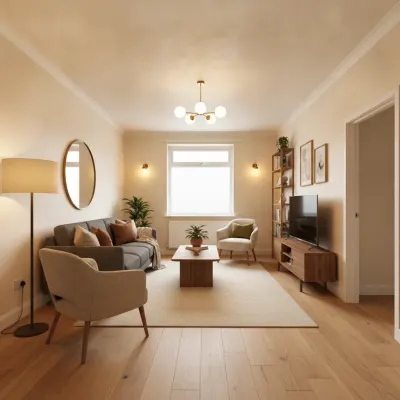 Éclairage
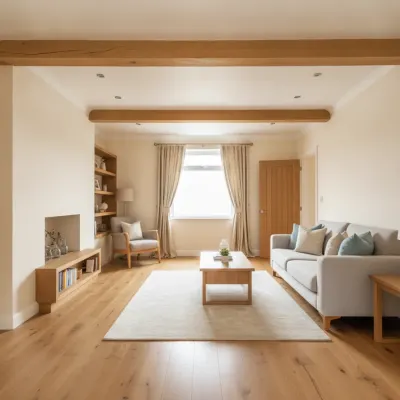 Plafond
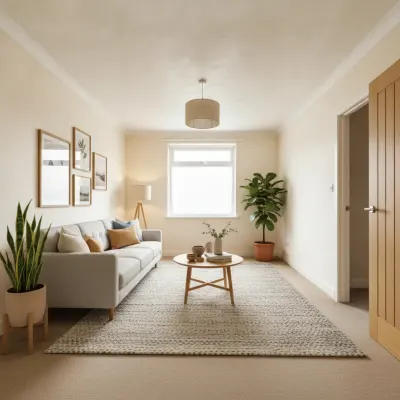 Décoration